Phenotypic Characterisation of Kisumu Colonies
Laboratory testing of insecticides relies on standard susceptible reference strains, and ‘Kisumu’ is the most widely used insecticide-susceptible strain of Anopheles gambiae. Working with partners at sixteen testing facilities, we coordinated a multi-site study in which each facility exposed its own Kisumu colony to four insecticides (permethrin, alpha-cypermethrin, DDT and pirimiphos-methyl) in WHO tube assays, using treated papers prepared at LSTM and a standardised protocol.
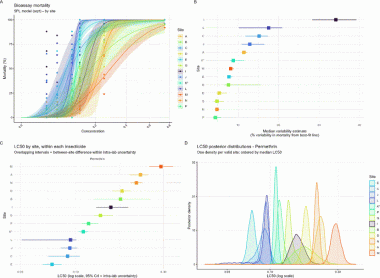
Responses differed substantially between colonies — LC50 values varied by up to 4-fold for permethrin, 6-fold for pirimiphos-methyl and 15-fold for alpha-cypermethrin — and some colonies would be classified as resistant under the WHO definition. This challenges the assumption that Kisumu is a consistent susceptible standard between facilities, with implications for comparing results between studies. We have proposed genotypic analysis of the colonies to identify signs of contamination from resistant or wild mosquitoes, and guidance to support the maintenance and monitoring of susceptible strains.
A preprint describing the study is available on VeriXiv.