Screening Candidate Volatile Compounds
Spatial emanators have received their first WHO recommendation, opening a new product class for vector control. The products closest to market are all based on a single volatile pyrethroid, so new active ingredients with different modes of action are needed – and a laboratory screen for candidate volatile compounds would be faster and less costly than the semi-field testing currently used for first-stage screening.
Working with a research consortium developing second-generation spatial emanators, we are developing a lab-based screening platform built around the Peet-Grady chamber, complemented by benchtop assays, and applying it to a shortlist of candidate compounds selected by partners through semi-field testing. Candidates are evaluated against Anopheles gambiae across toxicological and behavioural endpoints – knockdown, mortality and blood-feeding inhibition, with blood-feeding inhibition the priority. The work includes developing a laboratory proxy for blood-feeding inhibition, controlling temperature and humidity in the chamber to better reflect field conditions, and comparing ranked laboratory results with semi-field results to establish how well the lab screen predicts semi-field performance and to set criteria for progressing candidates.
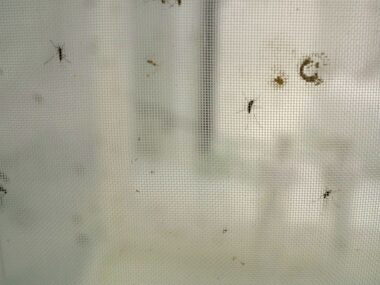
This screening applies the methods developed in our other projects, and in turn informs their refinement – a testing cascade running from benchtop assays through to free-flight chamber evaluation. Standard operating procedures from the work will be transferred to the Liverpool Insect Testing Establishment (LITE) to support future screening of candidate volatile compounds.
This work is supported by IVCC.