The Two-Tube Volatile Assay
Established susceptibility bioassays expose mosquitoes to insecticide-treated surfaces, so they cannot measure responses to vapour-phase actives such as transfluthrin, the active ingredient delivered by the first WHO-approved spatial emanator products. We have developed the Two Tube Volatile Assay (TTVA), a non-contact benchtop bioassay adapted from the WHO tube test, in which mosquitoes are exposed to transfluthrin vapour and scored for knockdown over 60 minutes and mortality at 24 hours.
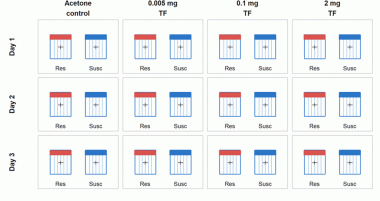
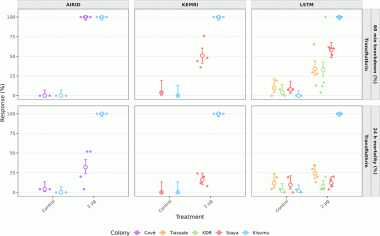
A method article describing the TTVA was published on VeriXiv in October 2026 (awaiting peer review), with dose-response data from three laboratories: LSTM, AIRID (Benin) and KEMRI (Kenya). The assay generated concentration- and time-dependent responses and resolved differences in transfluthrin response between susceptible and pyrethroid-resistant strains at all three sites, with 24-hour mortality recommended as the primary endpoint. Strains uniformly classified as resistant in contact bioassays ranged widely in their response to transfluthrin vapour, suggesting that contact phenotypes may not predict vapour susceptibility.
The method is part-way through a staged validation process: work on robustness and inter-laboratory transfer is ongoing, with partners including CRID (Cameroon) and KEMRI (Kenya). As well as supporting entomological monitoring across other pilot studies and trials across multiple African countries.
Transfluthrin responses measured with the TTVA at the three laboratories. The assay separated susceptible from pyrethroid-resistant colonies at each site, and 24-hour mortality is recommended as the primary endpoint.
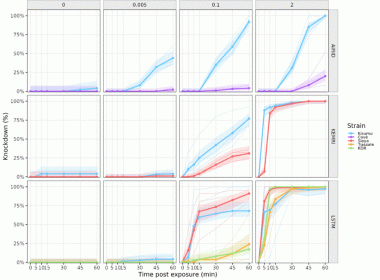
Knockdown is scored over 60 minutes of exposure, giving a concentration- and time-dependent response that can add information alongside mortality.
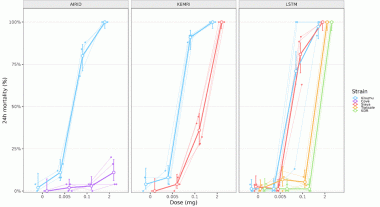
Mortality at 24 hours, measured across a range of transfluthrin concentrations, is used to estimate EC50 values and resistance ratios against local susceptible reference strains.
This work is supported by IVCC through the Gates Foundation and UK International Development.